Regional Licensing Shifts and Their Role in Shaping Free Spin Mechanics for Secure Mobile Table Play
Sofia Schwarz · Aug 12, 2026
Regional Licensing Shifts and Their Role in Shaping Free Spin Mechanics for Secure Mobile Table Play
Regional licensing frameworks have undergone notable adjustments in multiple jurisdictions since early 2025, and these changes directly influence how free spin mechanics integrate into secure mobile table play environments. Operators adjust bonus structures to meet updated compliance standards that vary by state and country, which means free spin features in table games such as blackjack or roulette variants must align with local rules on randomness, payout verification, and player authentication.
Licensing Adjustments Across Key Markets
States in the United States have introduced fresh licensing tiers that separate traditional table offerings from mobile bonus elements, and data from the American Gaming Association shows several jurisdictions updated their technical standards in the first half of 2026. These updates require operators to embed additional encryption layers around free spin triggers during live dealer sessions, ensuring that any bonus round generated on a mobile device passes jurisdiction-specific audit protocols before activation.
European markets have followed a parallel path, with certain countries tightening rules on cross-border mobile play while others streamlined approval processes for operators already holding multiple licenses. The result appears in altered free spin parameters, where spin frequency, wager multipliers, and eligibility windows now reflect the strictest applicable regional requirement rather than a single global template.
Mechanics Modification for Compliance
Free spin mechanics in mobile table play typically involve randomized bonus hands or card draws that mimic slot-style rewards, yet licensing shifts force developers to recalibrate trigger conditions and verification steps. When a new license demands real-time geofencing checks, for instance, the system pauses free spin sequences until location confirmation completes, which lengthens session flow but satisfies regulatory oversight.
August 2026 marks the enforcement date for several updated standards in select Canadian provinces, where operators must demonstrate that free spin outcomes remain independent of live table results even when both occur within the same app session. This separation requirement has prompted coding changes that isolate the random number generator used for bonus spins from the one handling card shuffles.
Security Protocols and Mobile Integration
Secure mobile table play relies on multi-factor authentication combined with device-level encryption, and regional licensing increasingly ties these measures to bonus eligibility. Jurisdictions now often mandate that free spin credits appear only after a player completes a fresh security handshake, reducing opportunities for session hijacking while maintaining seamless play once verification passes.
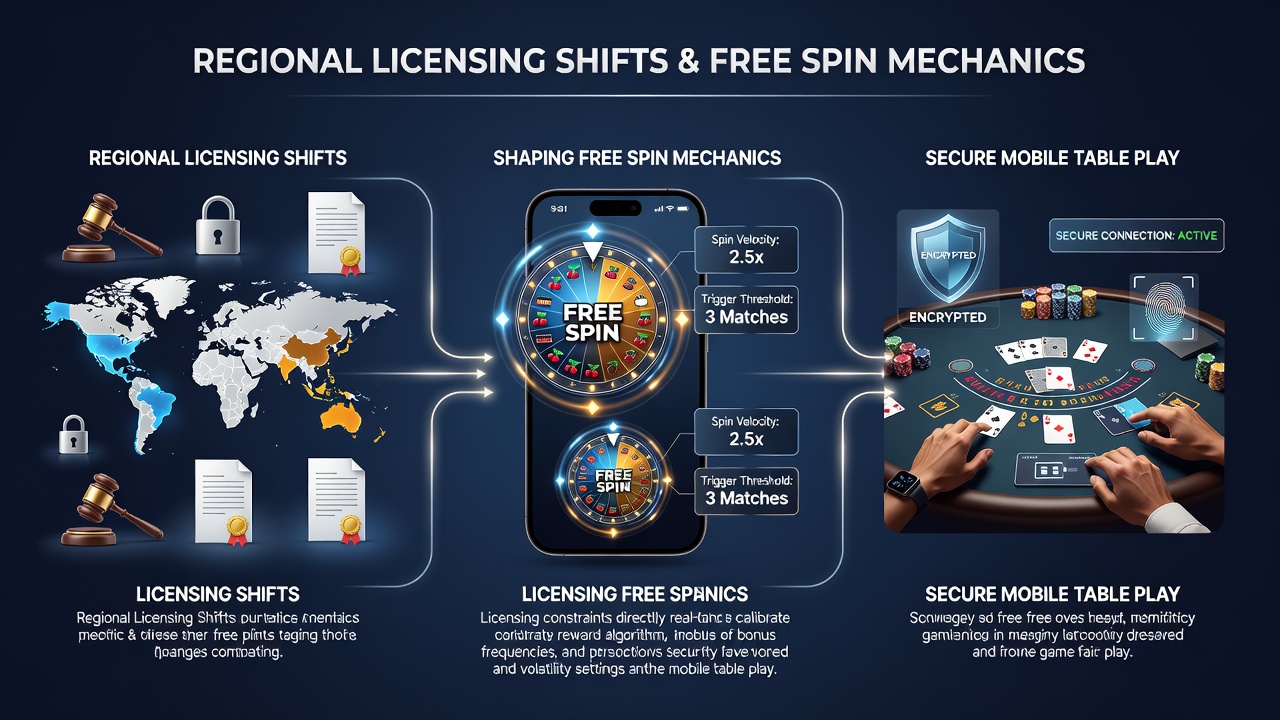
Operators report that these layered checks have become standard in apps serving multiple regions because a single codebase must satisfy the most demanding license conditions. The approach avoids separate versions for each market and instead uses conditional modules that activate based on detected player location and license profile.
Examples from Different Jurisdictions
One operator group operating across three U.S. states adjusted its free spin mechanics after two of those states revised their bonus disclosure rules in late 2025. The updated system now displays region-specific terms before any bonus round begins, and it logs the display timestamp to meet audit requirements. Similar adjustments have occurred in Australian markets, where a government-linked research body documented shifts in how mobile platforms handle bonus resets following license renewals.
Those who manage multi-jurisdictional platforms note that free spin mechanics must now include fallback options when a player crosses into a stricter regulatory zone mid-session. The app automatically converts pending spins into equivalent table credits or pauses the feature entirely, depending on the destination license rules.
Future Alignment Trends
Industry reports indicate that ongoing harmonization efforts among neighboring regions could reduce the need for such frequent mechanic tweaks, yet current licensing cycles still produce incremental changes each quarter. These adjustments keep free spin features functional while preserving the security standards required for mobile table environments.
Conclusion
Regional licensing shifts continue to drive targeted modifications in free spin mechanics for secure mobile table play, with operators adapting encryption, verification, and randomization protocols to satisfy varying standards. The pattern shows that compliance updates scheduled for later in 2026 will likely extend these adaptations rather than reverse them.